|
Mexico 1963
...Internship |
|
My fascination with Latin Music soon
became an interest in Latin America. Through the graces of Herbert
E. Evans, then President of Nationwide Insurance's Peoples
Broadcasting radio division and a "friend of a friend of the family"
I was put into an informal exchange program through which I would
theoretically complete my Junior year in High School in Mexico City- |
|
 |
|
Central Mexico at nearly 7,500 feet altitude was a very
different environment than the rustbelt winters of
Cleveland. |
|
This was partly
correct. Once I got to Mexico, I did not ever go beyond
matriculating in the school. The next day, I visited Organización
Radio Centro, which operated 5 AM stations from palatial studios in
the old downtown section of Mexico City, the world's largest
commercial radio market. While there, I literally bumped into XEJP
and XEQR Program Director Ramiro Garza, who was fascinated by a
young foreign visitor who was interested in the ORC stations. He
mentioned that the stations had an internship program; the rules
were to not speak unless spoken to and to do everything asked for. I
became an intern and never stepped in the school I was supposed to
attend. |
|
 |
|
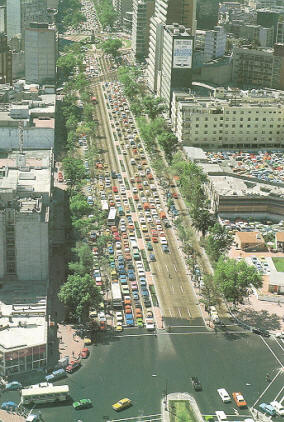
Reforma Avenue runs
from the old downtown to Chapultepec Park, and is among the world's
busiest. |
|
 |
|
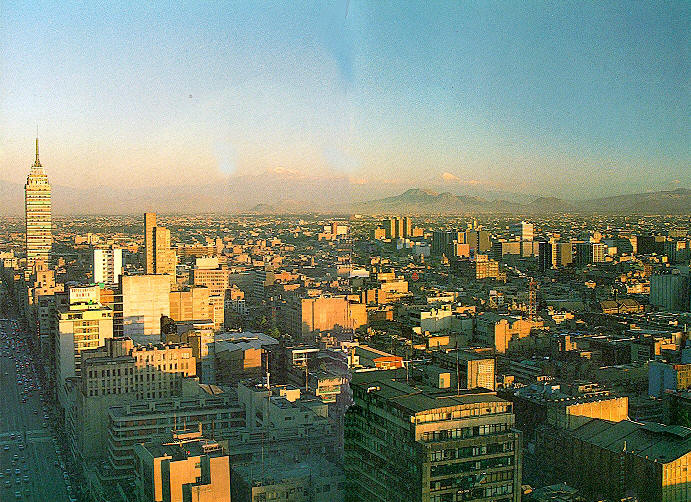
This skyline, taken
in the 60's, shows the residual smog and haze that
has reduced visibility to as little as a half-mile
now. |
 |
|
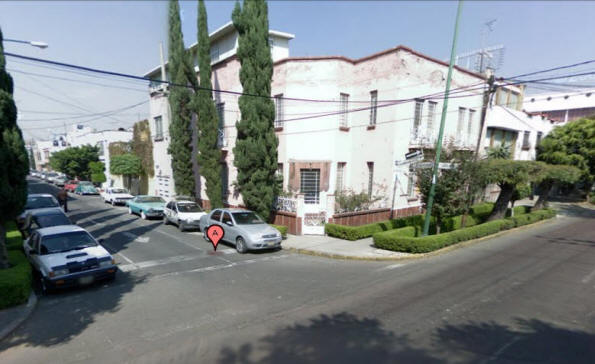
This is the home at Gabriel Mancera 139 in the
Colonia del Valle in Mexico City where I lived in
1963, in a Google 2008 photo over 45 years later.
The Otero familyt kindly tolerated my obsession with
radio and helped me find my way around this enormous
city of 8,000.000 in that year. |
|
I spent part of 1963
learning to cart newscasts, carrying spots to the dubbing room and
filing records. At the same time, I saw that format radio worked in
Mexico. It was the same structure, just in a different language. The
jingles were all PAMS overdubs and much of the music on several of
the stations was cover versions of American Top 40 hits! |
|
 |
|
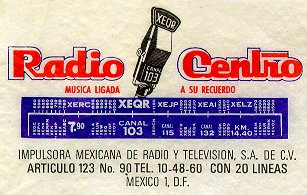
Radio Centro, now
"Grupo Radio Centro" (NYSE: "RC"), and its 5
stations had nearly 30% of the audience in the 1963
market of 32 AM stations. They had a bilingual Top
40, a Spanish Top 40, a tropical music station, an
MOR format and another facility playing all ranchera
music. |
|
 |
|
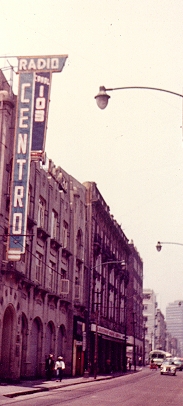
This is my 1963
snapshot of the Radio Centro offices and studios on Artículo 123
Street N° 90 in Mexico City. The unpretentious exterior housed
marble hallways and state of the art equipment. |
|
 |
|
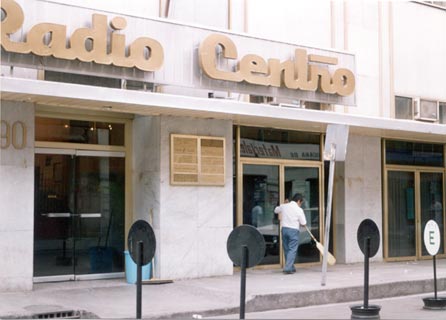
Another view of the
exterior of the Radio Centro building in the old
downtown area in the 70's. |
|
 |
|
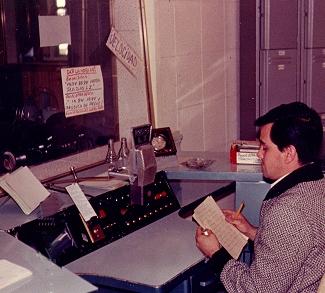
This is the studio for Radio L-Z
(XELZ) which was an all-ranchera station. The signs on the window
say, "Keep up the Pace" and remind the DJ to give the name after
every song. |
|
In addition to
interning, I visited a number of other radio
stations and took pictures of many. There is a
section of pictures of other Mexico City stations
at: |
|
Mexican Radio Station Photos |
|
 |
|
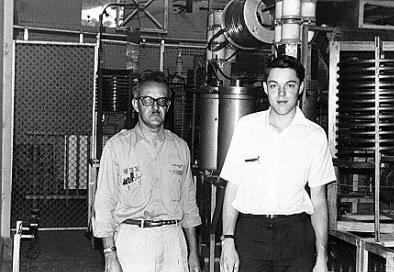
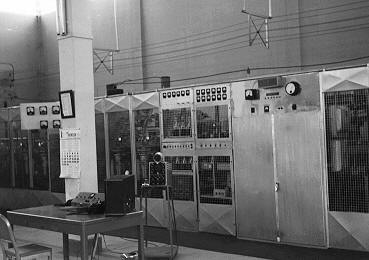
This is the inside of one of XEW's three 250,000 watt transmitters
as used in through the 70's. Home-made, they were water cooled and
alternated on air for two-hour periods. XEW also operated XEWW on
short-wave, and repeater stations in several major markets of
Mexico. The gentlemen on the left is the XEW transmitter engineer.
I'm the guy with the pocket protector on the right. |
|
 |
|
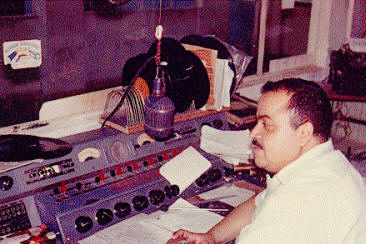
A front view of one of the XEW transmitters. Note the open
transmission line above. |
|
 |
|
Here is a shot of a typical smaller
Mexico City station, XEMC-1590 AM. Note the interesting mike mount.
The little mallet the the announcer's right (lying on the paperwork)
was used to strike the official station chimes which served to
identify XEMC and many other Latin American stations of the era. |
|
 |
|
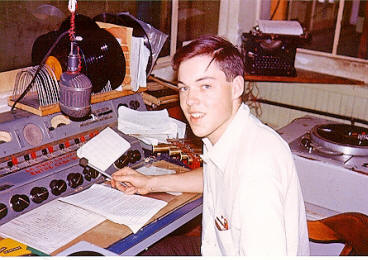
And, ready to use the chime (to the right) is the
slightly younger station visitor, who was
immediately invited to sit down and have a picture
taken by the friendly staff. |
|
 |
|
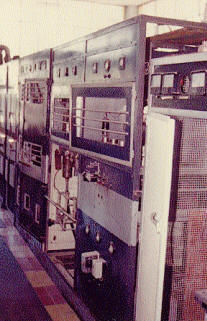
The XEMC transmitter. The open cabinets are part of XESC, the
short-wave affiliate which seldom stayed on the air very long.
Through the 70's, short-wave was common in Latin America, where
rural areas often did not have radio stations. |
|
Following my time in
Mexico, I traveled for several months through Central America and
Colombia, visiting every radio station I could find. Elsewhere on
this site you can find an assortment of pictures of the stations of
this region as they were in 1963. |