Ecuador 1964 - 1970
David Gleason's radio
stations in Ecuador : Radio Musical Canal Tropical
Núcleo Radión
Teleonda: Ecuador's first FM station. |
|
In 1964, in a further attempt to
finish my next-to-last year of High School, I found an opportunity
to study in Guayaquil, Ecuador, with assitance from Herbert Evans,
the head Peoples Broadcasting (Nationwide)
Unfortunately, when I arrived, there
had just been a revolution to depose the sitting president,
Carlos Julio Arosemena Monroy. Schools in Guayaquil were unable
to overcome a disrupted bureaucracy and admit a new student,
especially one without the necessary "normal" prerequisites in
Ecuadorian history and such. |

Ecuador lies ont the
Equator in Northwestern
South America.
In 1965, the population was
just under 4.75 million. |
My original destination of
Guayaquil is on the
Southwestern coast of Ecuador, slightly inland on the Guayas River.
This is Ecuador's largest city, but it is hot and humid year-round. It has long been the economic force
of the nation, with the main banks and industries.
Quito is in the
central mountains, and, at 10,000 feet above sea level, cool and
Spring-like all through the year. It is the capital, intellectual
and diplomatic center of Ecuador.
In 1964, Guayaquil had about 1.2 million residents,
while Quito was a city of about 800,000. |

Map courtesy of Lonely Planet |
|
 |
 |
|
Click to hear the Instrumental
Ecuadorian National Anthem |
Click to hear the Ecuadorian
National Anthem with chorus. |
|
 |
|
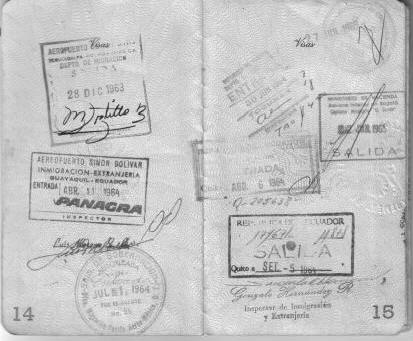
My passport stamped for my first entry to Ecuador |
|
| Not wanting to go back to the US, and abandoning the
formal "exchange" program that got me Ecuador, I
traveled to Quito, the capital, where I was told greater
leeway was granted to foreign students in deference to
the diplomatic community. That was true, and I was
accepted at the Colegio Americano ("Americano" refers to
"The Americas" and not the United States of America)
where I was introduced to classes unknown in Ohio such
as Logic and Ethics, as well as practical ones like
"Redacción Comercial" (Business Spanish). All
instruction, of course, was in Spanish. |
 |
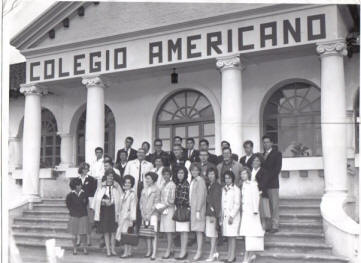 |
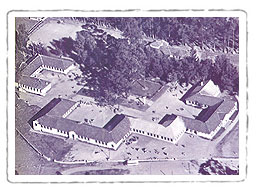
| The Colegio Americano
campus around 1964. Click on the picture to read about the
Colegio Americano. The school was founded in 1940 by Galo Plaza Laso, former
President of Ecuador and General Secretary of the Organization
of American States. President Plaza is shown in the panel at the
left, standing in the center of the group. |
|
|
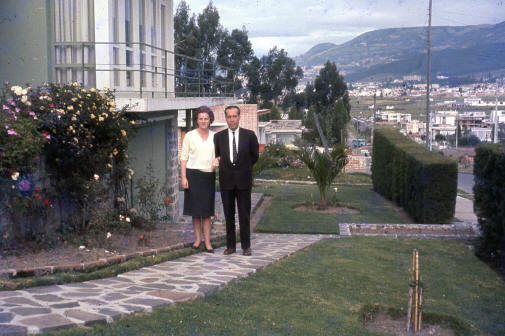 |
My Ecuadorian "parents" Florence and Dr. Galo
Ballesteros at their home in
El Batán overlooking the northern part of
Quito. |
|
Amid a busy course schedule,
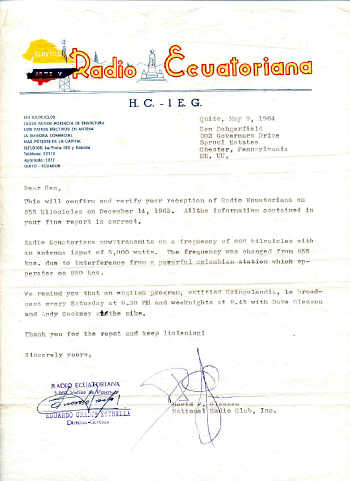
I found time to visit most of the stations in Quito. At one,
Radio Ecuatoriana, the owner invited me to do a radio program
with Top 40 hits from the US every Saturday. I also answered
some of the station's English correspondence, like this request
for a reception verification. I couldn't spell or proofread
then, either. The show, called "Gringolandia," lasted until I
made the decision to have my own radio station.
The letter to the left,
received by a radio listener in Pennsylvania in 1964, confirming
reception of Radio Ecuatoriana is signed by the station owner
and one David Gleason. |
 |
|
|
|
While browsing
the stores and sights in Quito's colonial downtown, I spotted a
store with a radio transmitter in the window. I went in to see
it, and the proprietor, Ing. Al Horvath, saw me peering into the
innards of a 1,000 watt radio transmitter with uncommon interest
and curiosity. |
|
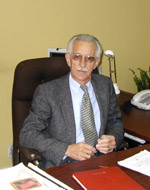
Carlos Guarderas Barba in 2005.
Carlos managed Ing. Horvath's business |
|
Somewhat
amazed about my interest in a transmitter (I
looked every bit of 17... or less), I explained
my several years of "work" in radio. Horvath
confessed that he had built the transmitter
hoping to sell it to someone, bundled with a
license his son in law, Carlos Guarderas had
obtained for a new AM in Quito (where there were
already about 40 other AM's). |
|
Unfortunately, no one wanted that frequency: 570 AM.
In Ecuador, stations did not use towers, preferring instead to
use long-wires hung between tall wooden poles. Of course, a low
frequency would not tune easily in to such a short antenna, and
so this channel was available... for a price of U$S250 dollars
(I had to buy the transmitter I had been admiring, too. And the
tower. And the ATU... there was a catch of kinds.).
|
|
|
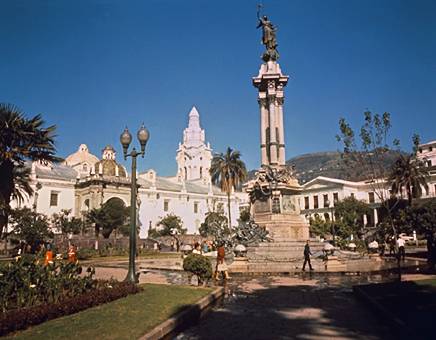
Independence
Square in Quito, circa 1967.
The Cathedral is behind the park.
The picture was taken from the portals of the Presidential Palace. |
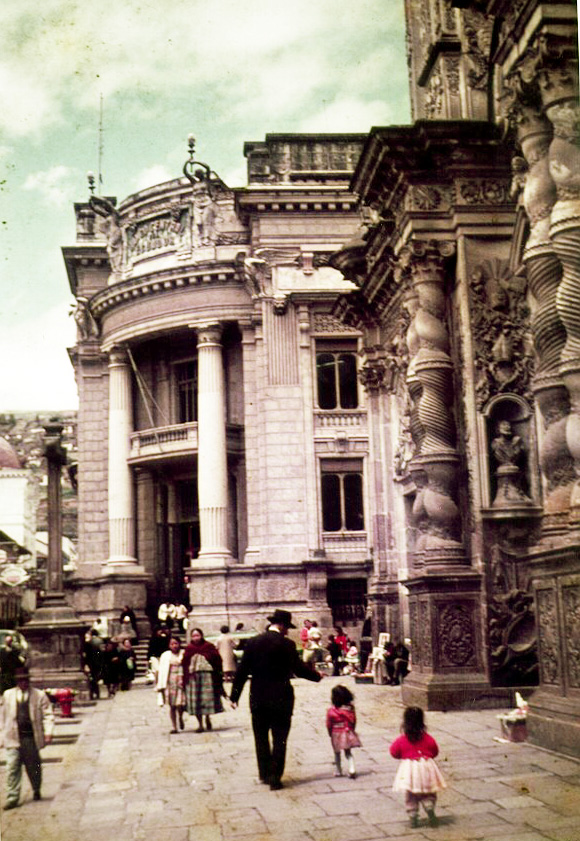
The Central
Bank is flanked by t
he entrance to the Cathedral. |
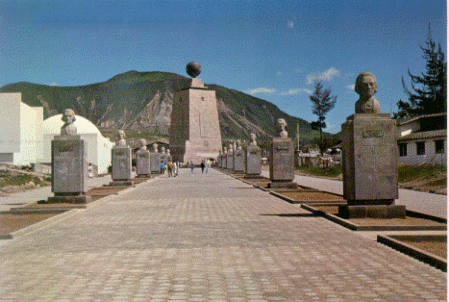 |
Quito is only a few
kilometers to the South of the Equator. Here is the monument as
it looks today at latitude 0.
Because the city is at an altitude of 10,000 feet
the climate is "Spring-like" all year around, going
from just above freezing late at night to the
mid-70s' during the daytime. |
|
| My late father had been an investment banker and managed money
all his life so most of my birthday and Christmas presents were
shares of stock, not Roy Rogers 6-Gun sets. From that beginning,
I had saved and invested since I was in the QSL card business,
and had a little stashed away. I decided that a city of 700,000
with nearly 40 operating stations badly needed one more. |
 |
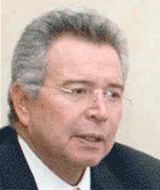
Francisco Aguirre Gómez of ORC |
I bought the transmitter equipment from Horvath, and headed to
Mexico to get record contacts and to buy jingles from
Organización Radio Centro and Francisco Aguirre Jr. At the same
time, I established contacts with the major Mexican record
labels to receive new releases. Peerless, RCA, Musart, Gamma,
Orfeón, and Columbia all were happy to hear about the first pop
music station in Ecuador.
|
|
 |
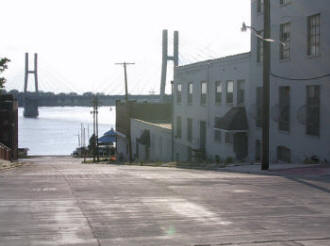
Larry Cervon managed Gates Radio Company in Quincy, Illinois. I
purchased all the studio equipment from Gates during a visit to
Quincy. The former Gates factory was on this street in Quincy, with
the Mississippi River at the end. |
 |
|
| In September, 1964, we were
ready to put the tower up. The transmitter site was on a flat
hilltop to the NE of Quito which we happily found had nice
conductivity because it was very loamy and less rocky than other
areas of town. Quito lies along a long sequence of valley areas in the high Andes. |
Here are a series of photos
of the construction of the transmitter site
for Quito's new
HCRM1, Radio Musical, on 570 AM. |
|
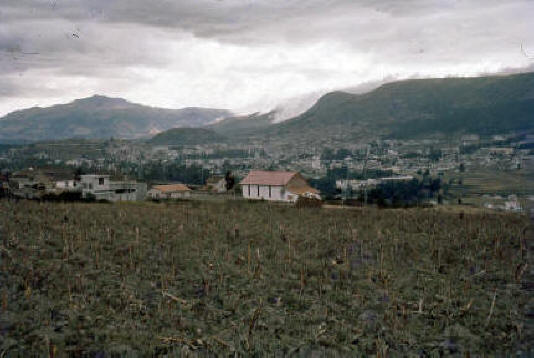 |
| The transmitter
site before any construction in late August of 1964. The city of
Quito lies below the site, which was over 10,000 feet AMSL. The view
is form the Northeast, looking over the central and northern part of
the city. |
|
 |
|
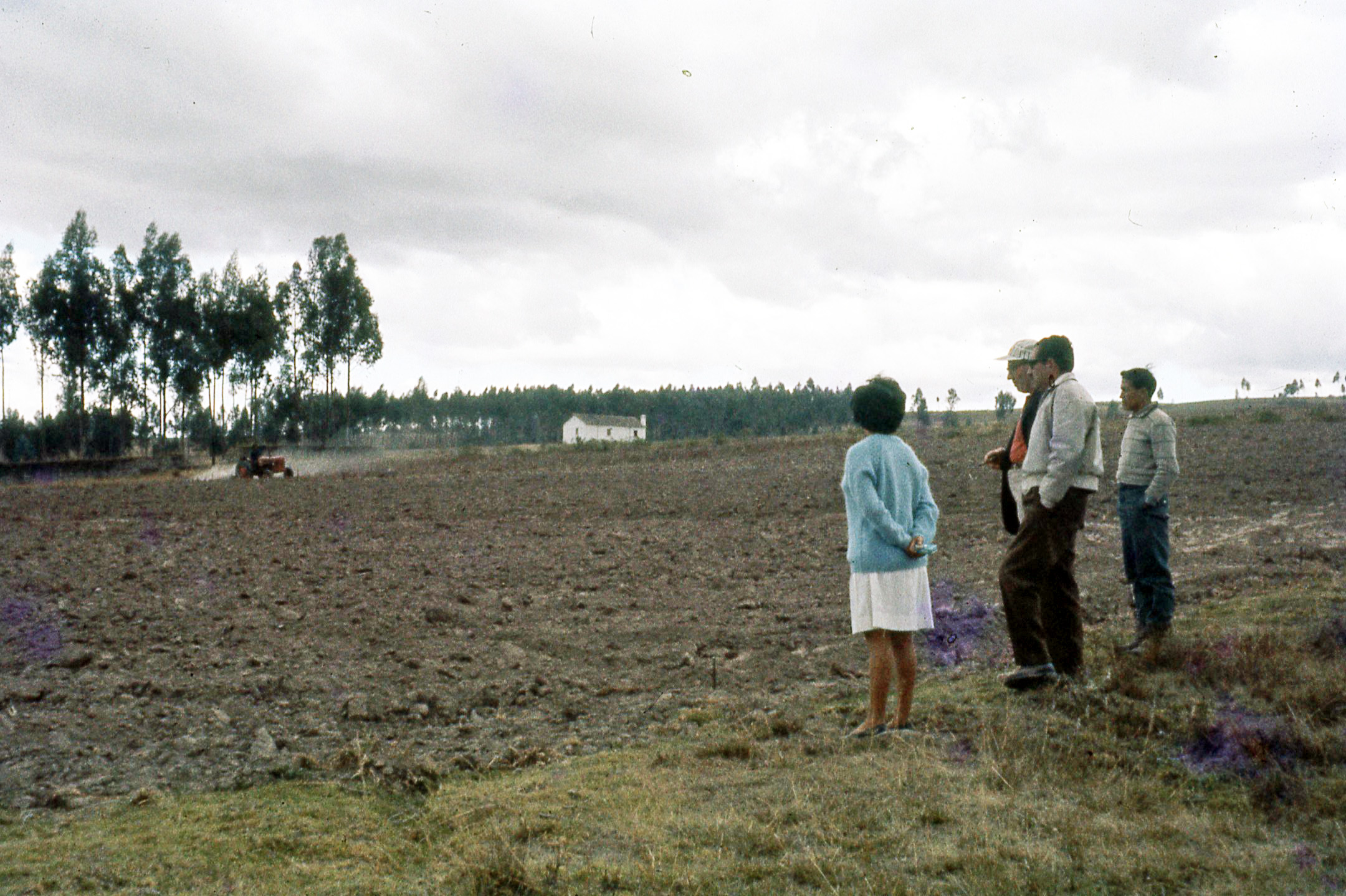
Plowing the furrows for the 120 ground wires that
will be buried under the earth... 8000 meters of copper wire or
enough to lay a single strand from the site to downtown Quito. |
|
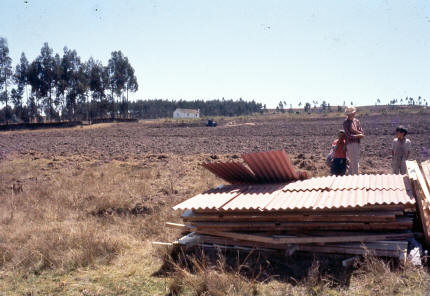 |
The "caseta" or transmitter building was
prefabricated, and sported a very
handsome pure asbestos roof. |
|
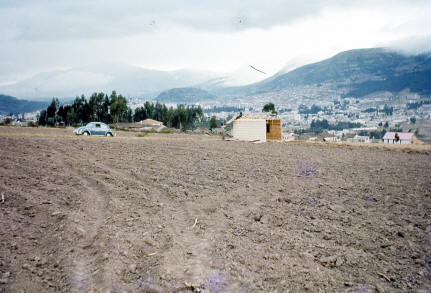 |
Construction begins
with the transmitter building, prefabricated by a local carpenter.
Note the land freshly plowed and turned to make burying of radials
easier. 5 miles of copper was buried for the ground system. At the
time, other stations simply buried an old car radiator as a ground! |
|
 |
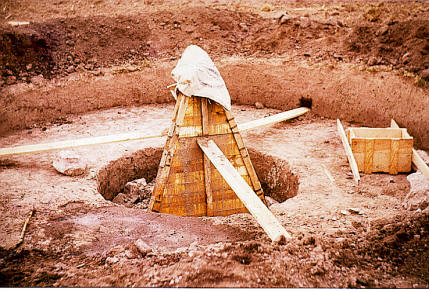 |
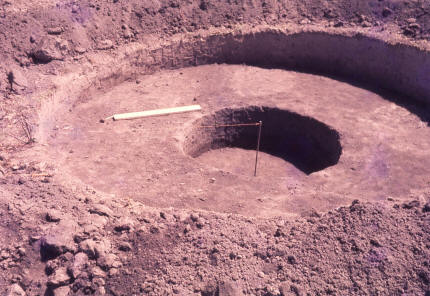
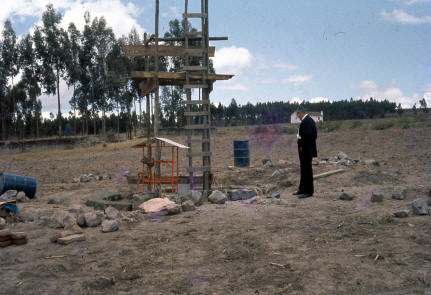
| A nice hole is ready
for the tower base to be poured and then cement
is poured in it and cures in its wooden form; bolts
to hold the tower base are protected by a cloth
cover. |
|
 |
|
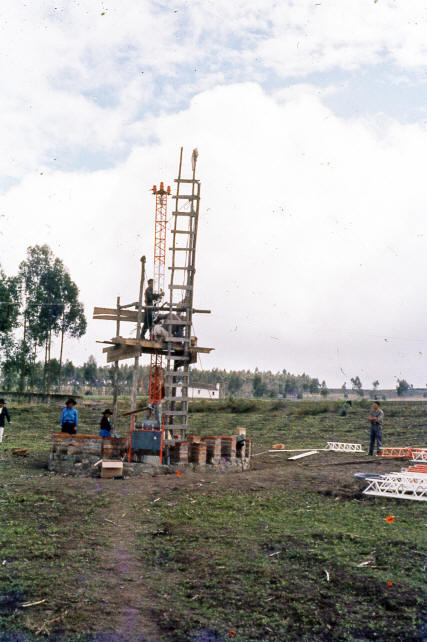
Ing. Horvath surveys
the base and the frame for the doghouse (antenna
tuning unit)- The interesting scaffolding had a
purpose: the tower was erected top section first
and winched upwards, with new sections being added
to the bottom. A crew of farmers manually held guy
wires and ropes as the tower rose. |
|
 |
|
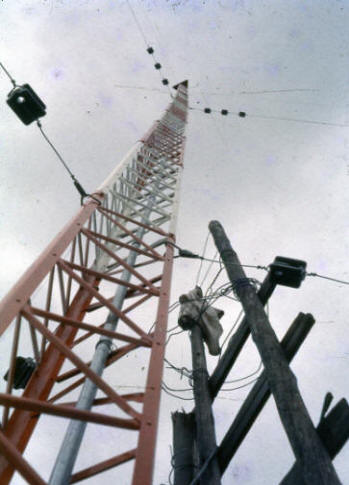
The first and topmost
section is assembled; other sections lie to the
right.
Note the beacons and lightening rods on the tower. |
|
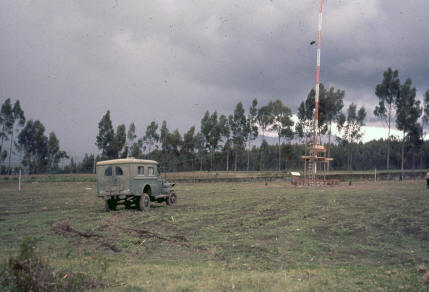 |
| This old truck
carried the winch that pulled the tower upwards
using the wooden scaffold as a gin pole. |
|
 |
 |
|
Seen from the
scaffold, here the tower is part way up, and still
not tensioned properly. There is, in fact, a
pronounced lean at the top. |
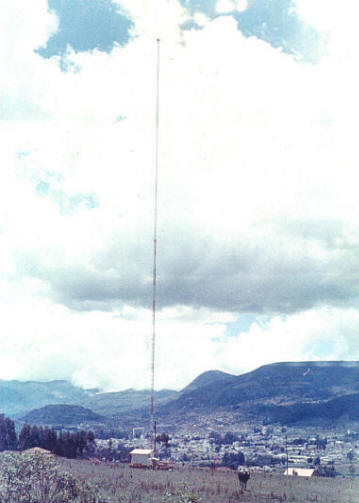
"Towering" over Quito
from the suburban area of Bellavista, HCRM1 looked
to have a huge tower. In fact, it was only 100
meters
high, with enormous top-loading to work on 570. |
|
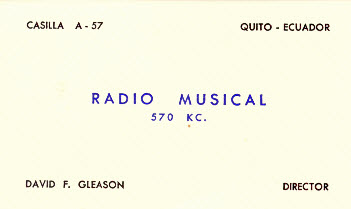
| My first business card as owner of a radio station. "Director"
was a more common term than "General Manager" and indicated, of
course, ownership as well. When Radio
Musical went on the air, there were nearly 40 other AM stations
in this market of 700,000. |
 |
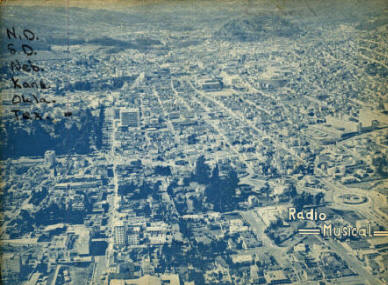 |
This was
the cover of the original sales presentation for Radio
Musical... Quito stations did not have such things in 1964 and
all rate cards were verbal! (and rates, were, shall we say,
fluid.) HCRM1 had
the highest rates in the market... and a commercial limit of 10
minutes an hour at a time when 30 minutes was common. Click
HERE
to see a list of all the
competitors in 1964!
To serve this market, Radio
Musical went on the air the 5th of December of 1964. |
|
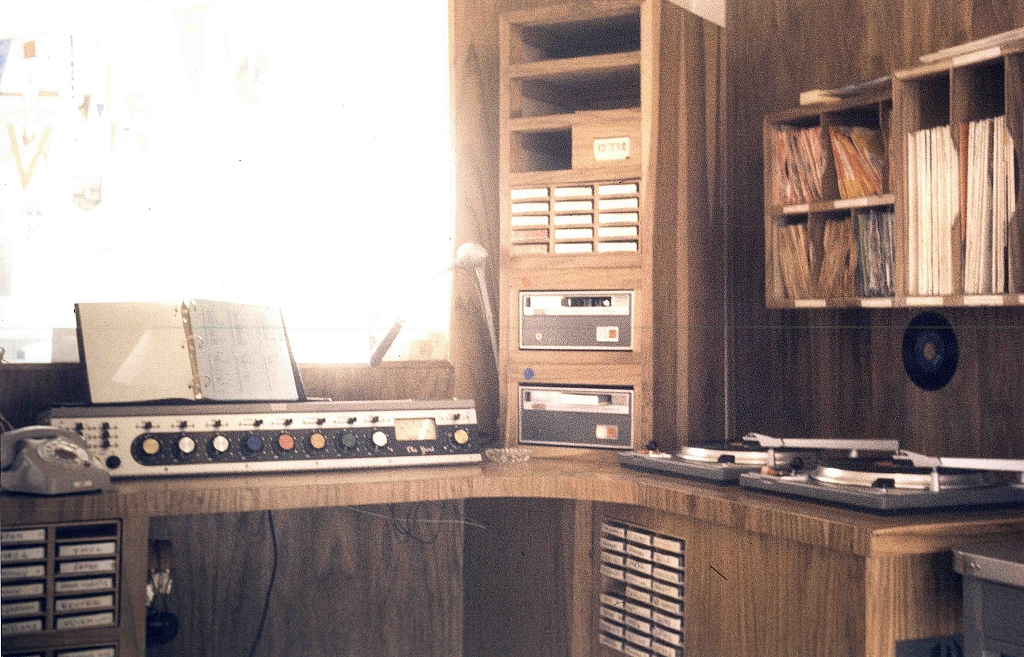
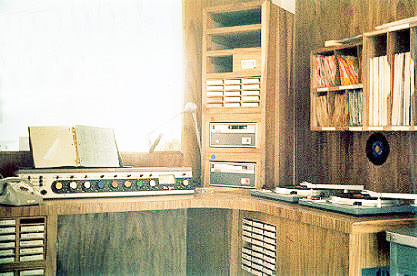
The first cart machines in Ecuador were at Radio
Musical. It also had the first solid state audio
chain (Audimax and Volumax).
Click on the picture for a higher
resolution view of the studio. |
 |
|
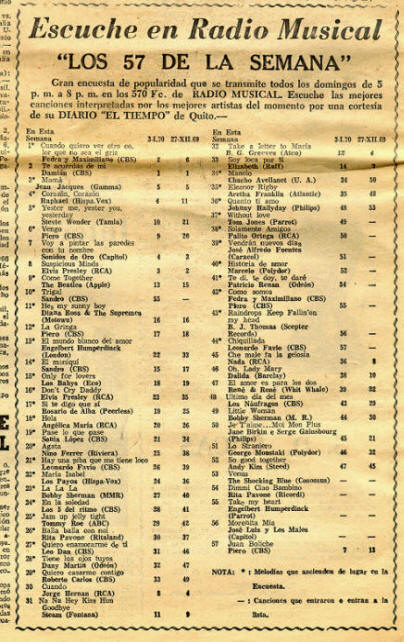 |
A "57 of the Week" from the late 60's.
Click
on the chart to see a more readable PDF version.
As
befitting a Top-40 station, Radio Musical had its "57 of the
Week" and the list of the city's most popular songs was
published every Sunday by the Diario El Tiempo in Quito, and the
entire hit parade was counted down at 5 PM! (The #1 song was by
Argentine duo Fedra & Maximiliano, and the #8 ranker was
"Suspicious Minds" by Elvis Presley.
Radio Musical
played the hits no matter the language... there were many French
and Italian songs on the list as well, and we made an annual
trip to the San Remo Festival in Italy to bring back the
competing songs which always found great acceptance (and was
sponsored by Ing. Luigi Perotti, the importer of Borletti sewing
machines).
|
|
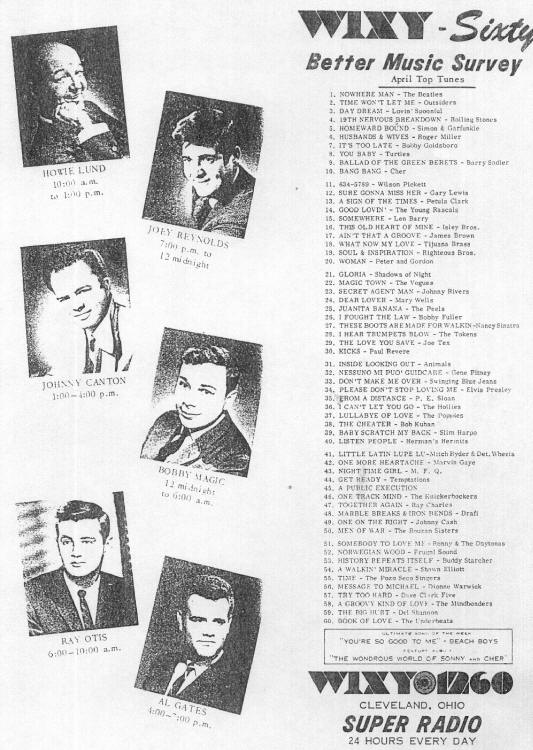
Radio Musical
played lots of hits from the US; of course, they were not
available in Quito anywhere. So my mother, each and every week
of the year, went to a record distributor in Cleveland and sent
the new songs that had just debuted on the WIXY chart! A few
days later, the same songs were heard on Channel 57 in Quito, to
the obvious delight of our listeners |
 |
|
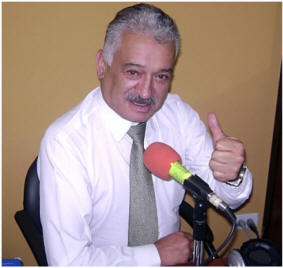 |
Patricio Toro, one of
the best announcers on Radio Musical and Canal
Tropical. Click on the photo for an interview (in
Spanish) with Patricio where he describes how he was
hired by me. Part of that interview appears below:
|
| "Later... I received
several phone calls from a gringo who spoke horrible
Spanish that I could not understand, who invited me
to visit a station he had just built and which had
the the absolute best technology that existed at the
time, and which had recruited the best announcers of
the time and I thought he was playing a joke on me
and I never paid any attention until I got a call
from Guillermo Jácome, one of the the best voices
ever and he said that Mr. David Gleason, a US
citizen, had called me and he requested that I come
for an interview to the facilities of |
the station that would
become Radio Musical AM. I went and
they offered me a salary that was ten times greater than what I
was making plus all the required benefits, and later it became
the leading radio group in the country, Núcleo Radión, made up
of Radio Musical, Canal Tropical, Radio Fiesta on AM and
Teleonda Musical on FM, the first commercial FM (in Ecuador) At
Canal Tropical, I spent a wonderful era in my career and was
also the official voice of the Núcleo Radión and of Teleonda FM.
" |
|
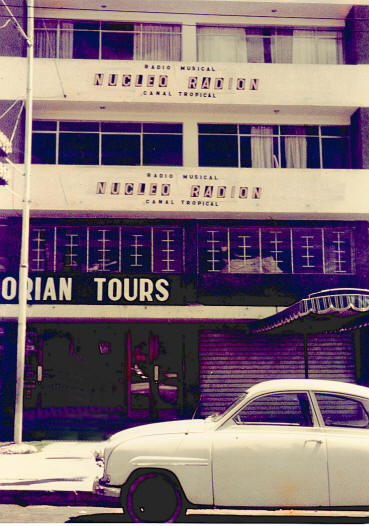 |
The station
was located in this building on Avenida Colón in the more modern
northern part of Quito for its first 3 years. The signs on the
second and third floor say, "Núcleo Radión" which was the name
for the growing station cluster after Canal Tropical-805 was
added in 1966.
In 1967, we were evicted from the building
for being too noisy for the other tenants. In less than a week
we built new studios and moved the three operating stations with
no loss of airtime. The ugly SAAB car was mine, being my first
experience in trade deals (three-for-one, anyone) |
| |
|
|
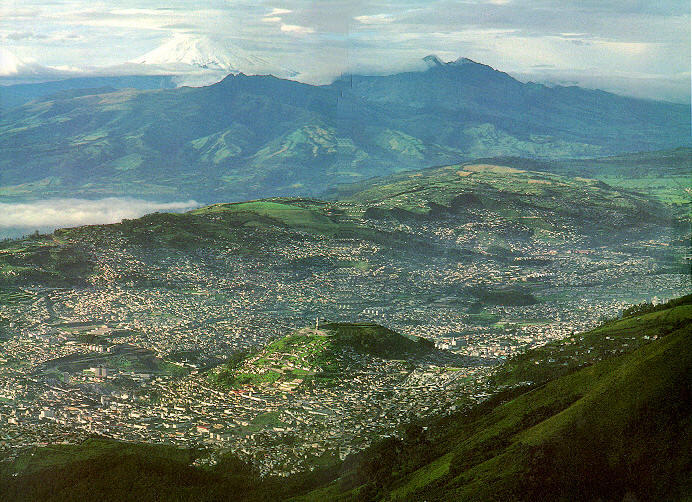 |
(Picture from the
future transmitter site of HCTM-FM located at the 14,000 foot level
on
Mt. Pichincha overlooking Quito from the West.)
|
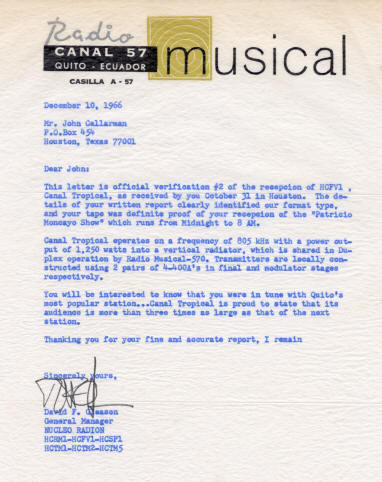 |
"Official
letter of Verification" sent to a listener in Texas who received
Canal Tropical in its first year of broadcasting.
Note that by late 1966 there were 6 sets of call letters for
the group. Click on the letter for a more readable PDF version
of the letter.
|
|
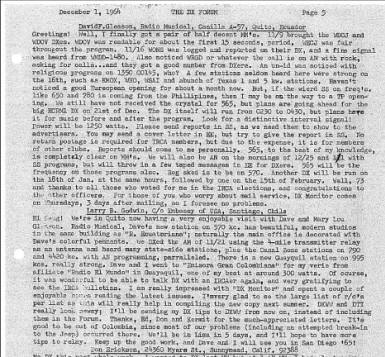
From the
International Radio Club of America's DX Monitor from December
of 1964 comes my DX report as well as the report of noted Denver
area DXer Larry Godwin who visited my station while touring
South America by Jeep!
Click the scan above for a
better quality PDF of the page.
|
 |
| |
|
|
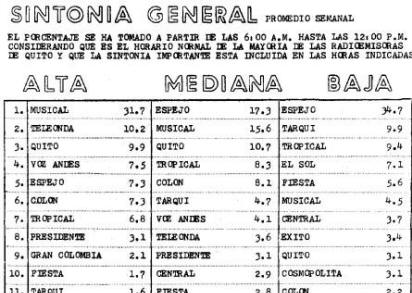 |
A "6
AM-Midnight" summary form a 1969 Datos, S.A. survey of Quito. In
upper income levels, my stations were #1, #2, #7 and #10 and
accounted for nearly 50% of listening. In middle income, 4 of
the top 11 were mine, and three stations had 20% of the lower
income audience. Click on the partial table for the whole page
of these 1970 ratings.
Interestingly, the #2
station in 1969 in upper income was an independent FM, Teleonda.
This station was the first independent FM in northern South
America and was profitable in its first year on the air. |
|
1965. Radio
Musical was a daring venture in retrospect. Against over 30
competitors, all with block programming, appeared the first Top
40 station in South America. Advertisers thought it was a
ridiculous proposition, as they were used to sponsorable block
programs, not a 24-hour music format. No one advertised. Our
first client didn't pay his bill... (I learned that it is not a
sale unless it pays.) A competitor referred to us as the "pocket
station" as only kids with pocket transistor radios listened.
Anyone with more experience in Ecuadorian radio would not have
done this crazy project.
By the sixth month, HCRM was only billing about $50
a month. |
|
We were a month away from
bankruptcy.
In June, a box arrived from Guayaquil, the
major ad center for Ecuador. It was from McCann-Erickson, and
had orders and acetate commercial disks for every radio account
they had, and for 15 to 20 spots a day each! McCann had done a
survey. The little new station was #1. Within weeks, we were
sold out.The station was under such demand that by the end of
1965, clients could only by Run-of-Schedule spots and a quarter
of the schedule ran between midnight and 6 AM. In the Datos
surveys, it was frequent to see the evening hours with shares in
excess of 75% of listening; the hours after 10PM came close to
100%. |
|
|
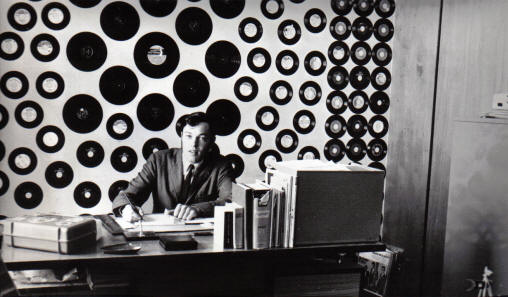
The "owner's" office at 1027
Avenida Amazonas in Quito. Records were the
decorating motif as can be seen from the following
pictures, too |
 |
|
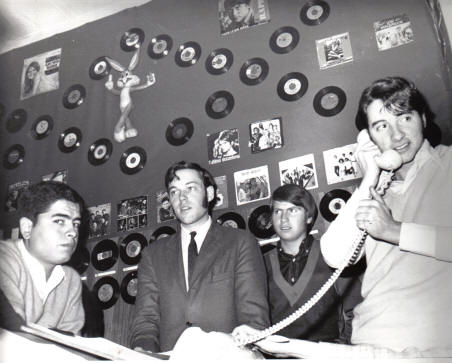 |
In
the Radio Musical Canal 57 studio (second from left)
with production manager Edwin Almeida (left) and "El
Pollo" Fuentes, Chile's top pop singer of the era.
Fuentes was taking listener calls as part of a
concert the station presented in Quito. |
|
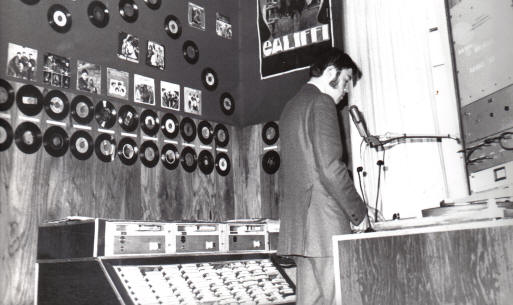
| At the "board" (a Gates Yard) at Radio Musical. The
Fairchild reverb, the Yard power supply and a CBS
Audimax were in the rack. |
 |
|
|
In an article in the Quito daily
paper "Hoy" Francisco Febres Cordero writes about La
Mariscal, the traditional upscale neighborhood of Quito where Radio
Musical and its sister stations were located. In the article, he
shows how much Radio Musical was a part of the culture and history
of Quito in the late 60's. |
|
"Muchos años
después -desplazados que fueron los caballos a
sectores ignotos- los autos continuaron
simbolizando en La Mariscal el paso de la niñez
a la adolescencia: los "hijitos de papá"
paseaban por la avenida Amazonas en un incesante
tránsito circular de todas las tardes a la
salida del colegio y todo el fin de semana, sin
otra misión que la de ser vistos por la
parroquia y la de admirar a las quinceañeras
que, a su vez, cruzaban en sentido contrario una
vez tras otra vez tras otra vez, al ritmo de las
melodías de Enrique Guzmán o Alberto Vásquez,
que Gabriel Espinosa de los Monteros o Pepe
Rosenfeld hacían sonar en la consola de Radio
Musical. A través de una de las ventanas de esa
casa, identificada con el número 1027, se
dejaban ver los primeros disck jockey de la
radiodifusión, para recibir, con sonrisa
conquistadora, el saludo de sus fans. |
"Many years later, the horses
having been removed to more remote areas, cars continued to
symbolize in La Mariscal the passage from childhood to
adolescence. The rich kids drove back and forth along
Amazonas Avenue every afternoon after school and every weekend
with no other goal than that of being seen and admiring the
young ladies, who followed the same circular route in the
opposite direction to the beat of the songs of Enrique Guzmán or
Alberto Vázquez that Gabriel Espinosa de los Monteros and Pepe
Rosenfeld played at the console of Radio Musical. From the one
of the windows of that building, identified with the number
1027, you could see the first disk jockeys of (Quito) radio, who
were ready to acknowledge with a winning smile the waves of
their fans." |
|
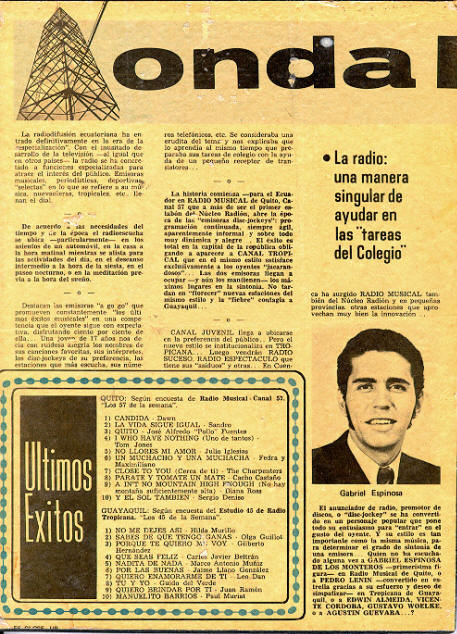 |
A
local magazine features the Radio Musical chart and night jock
Gabriel Espinosa de los Monteros.
The text reads:
"History,
for Ecuador, begins at Radio Musical in Quito, which, in
addition to being the first link in the Núcleo Radión (group)
opens the era of "disk jockey stations." Non-stop programming,
always agile, obviously informal, but always dynamic and happy.
Success is total in the Capital of the Republic, making
it necessary for Canal Tropical to soon appear, satisfying dance
music fans with the same style of radio. Both stations reach,
and still hold, the highest positions in the ratings."
No greater
compliment have I ever been paid. I was just 20 at the time. |
|
| 1966.
Radio Musical's success included the overnight show, where
tropical dance music was played; the show was sold out at
daytime rates. This unusual condition for a post-midnight shift
was widely commented and I was worried that someone might "take"
the format fulltime on a competitor.
|
One of the
other 40 AMs, Radio Pacífico, on 805 kHz, had tried to
compete with the Radio Musical format. They lost all their money
in the attempt. Fausto Vallejo Silva, the owner, offered me
HCFV1 for $2,500 or S/. 50,000. I snapped it up, closed the
station and had the transmitter chucked down a ravine (this was
pre-environmental awareness).
A new station appeared in
its place... using the name of the overnight show, "Canal
Tropical." I decided to tune the new station into the
tower of the first. Below is the the ad published by the
consulting engineer and showing the diplexer and ATU for the
first such operation in all Ecuador. |
Canal Tropical
debuted on the 21st of May of 1966. It was pure cumbia, porro,
gaita, mapayé, with a bolero or two thrown in for flavor. High
energy jocks played the hits 24 hours a day on this tropical
station with Top 40 formatics. A 15-day ratings sweep was half
way through that Saturday, but HCFV managed to show
nonetheless... at #1 in middle and lower income listeners!
And
the station’s
working class appeal was a perfect complement to the upper
income youth appeal of its sister station.
The first
song on the air was Sonia López' "La Pollera Colorá" which was a
hit cumbia at the time. ,
click here.
|
|
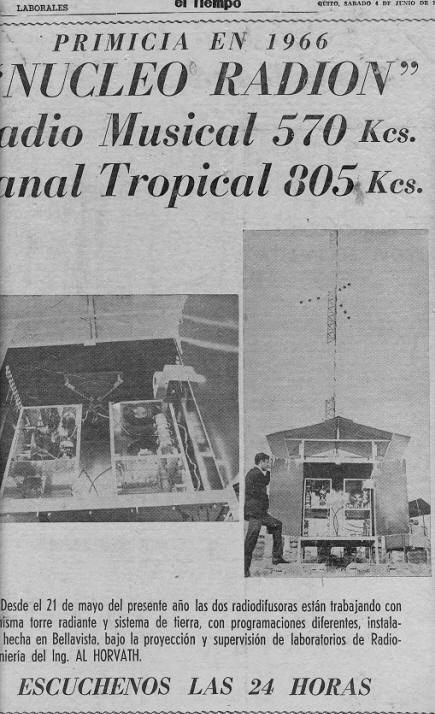 |
| Canal Tropical, HCFV1
was diplexed into the same tower as Radio Musical
using a tuning and rejection unit designed by Ing Al
Horvath. |
|
Growth
What do you do when you are sold out for two years, besides
raise rates every few months? You buy or build new stations.
This ad was from an advertisers guide published in 1967. There
were now four stations, including one very special one:
Ecuador's... and Northern South America's very first independent
FM station. |
1967.
At this time, Quito had only one TV station and no independent
FM facilities. A license was requested for the country’s first
commercial independent FM. Going on the air at midyear, easy
listening HCTM1 maintained a stance of "no commercials" for 6
months.
In fact, I had not intended to sell advertising
on the station ever; it was a tribute to my first job in radio
at an FM. But at lunch with a client, the distributor of
Ecuador's only instant coffee, I was asked to have my
salesperson drop by for a contract on the FM. When I mentioned I
did not sell ads on the FM, I was asked to name a rate... I
simply multiplied my highest AM rate by four to discourage the
deal. Surprisingly, he said yes... so I said, "the spots are
only 20 seconds" and was told this was fine. |
The appeal of
the format among advertisers became so high that "Teleonda"
achieved sellout within its first year. The format was a hybrid
of beautiful music and the traditional folk and national music
of Latin America. Three song sets would include two
instrumentals, and a vocal which might have been a tango, a
vals, a pasillo or a bambuco as well as trios and folksongs.
Total commercial time in each hour was two minutes, in six
twenty-second spots.
A year later, Teleonda became the
first stereo station in the country and moved its transmitter to
a small mountaintop overlooking the city. We went stereo by
modifying a test bench stereo generator intended for radio
repair shops and injecting it into our home made exciter. It lit
the pilot light on radios and had true stereo separation! |
|
| As can be seen from
the ratings from a few years later (graphic of Datos, S.A. table above on this page),
Teleonda was #2 in upper income listenership, and in the top 10 in
middle income audience. The station was always sold out... and this
was before 1970! FM had arrived and was successful in Ecuador before
the average FM in the US or Mexico was! |
|
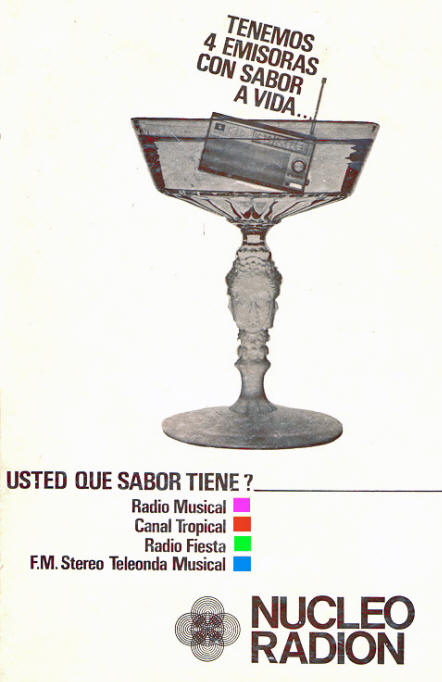 |
Thia ad appeared in an
advertising trade publication emphasizing the
variety of formats on the Núcleo Radión Quito
stations
"We have 4 stations with the taste of life.
And what flavor do you have?" |
|
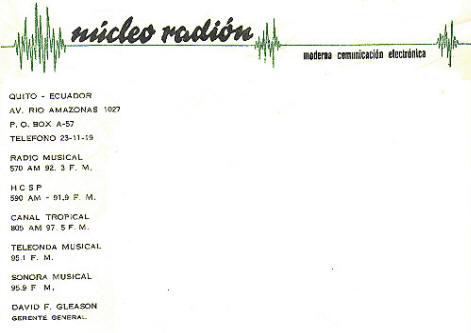 |
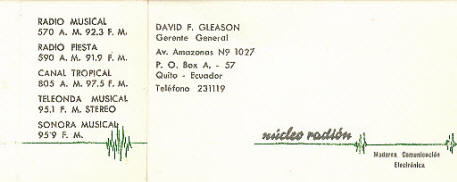
| Letterhead and cards for the group a few years later. Note that
there were FM simulcasts on each of the 3 AM stations, and two
independent FMs for a total of 8 stations in Quito alone. |
 |
|
1967. Our only
failure. Next to Radio Musical's 570 frequency there
was a rural station, some 60 kilometers outside of
Quito, at San Pedro de Amaguaña in the same province
of Pichincha. It was HCSP1, at 595 kHz. Recognizing
that the station could fit into the Quito dial, I
bought it via an intermediary and moved it to Quito
and had it reassigned to 590. A transmitter site was
built right off the Panamericana Sur, about 4 km
south of the Villaflora, in nice wet land. The
stations signal covered parts of 6 provinces.
I wanted to create the Ecuadorian equivalent of
Mexico City's Radio Centro, a nostalgia format with
boleros and trios and romantic crooners. The
playlist was extensive, as opposed to the Top 40
style of my other stations. It was called La Voz
Amiga.
Nobody listened.
|
Nobody. I
learned a lesson about playlist length, at some
cost. I also learned the art of the move-in, taking
a rural station and moving it to the big city. Of
course, nobody called it a "move in" yet!
But in 1968, I changed programming.
The one music format
was still missing: Ecuadorian folk music, the music
of the indigenous population. Another station had
shot up in ratings with the format, so 590 AM became Radio
Fiesta, and immediately made a profit. And quashed
the competitor, too. Although the
listener target was not much sought by advertisers,
there was considerable profit to be made in messages
for rural areas and greetings in general. Sold at a
premium, each stopset consisted of many "meet me at
the bus from Quito" and "your mother had her
operation in the city and is fine" announcements. |
|
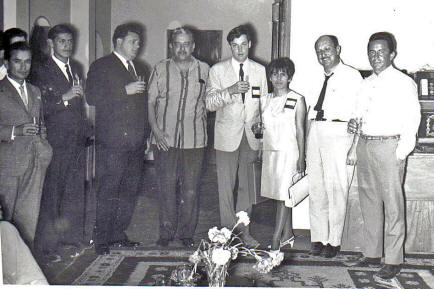 |
The 1967 Asociación Ecuatoriana de
Radiodifusión met in Guayaquil for its annual assembly. Here is
the opening reception picture with a number of other station
owners. |
|
|
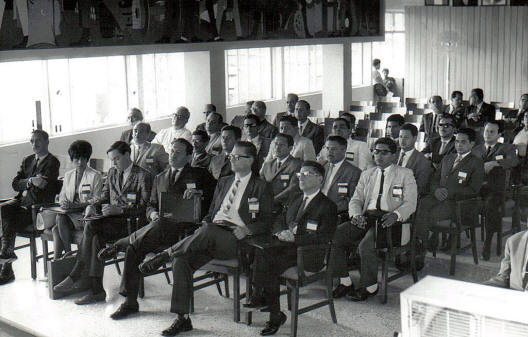
One of the meetings at the 1967 AER general assembly. Front row, far
left is Guillermo Jácome, operations manager of the Núcleo Radión
group. |
 |
| |
|
|
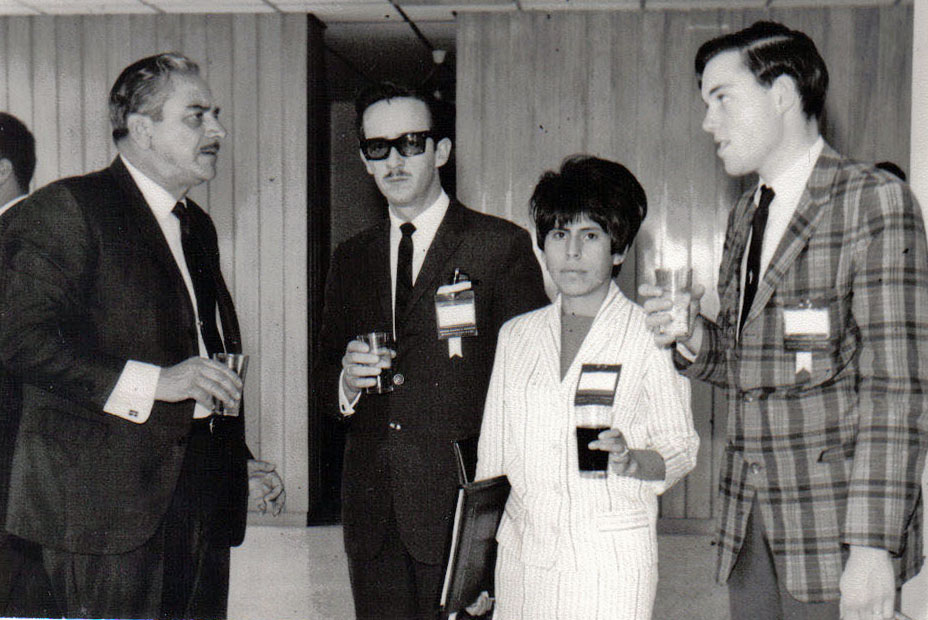 |
In 1968,
the Interamerican Asociation of Broadcasters held its convention
in Quito. I was asked by Arch Madsen, the US delegate, to assist
in the organizing of the event. Here is a surviving snapshot of
the opening night reception. To the left is Rafael Guerrero
Valenzuela, owner of CRE and Tropicana in Guayaquil. The
location is the Hotel Quito Intercontinental in the capital.
|
|
1969.
Another FM license was requested,
and HCTT1 signed on in 1968 with a mix of paid embassy
programming and classical music. Within a year, a weekend rock
program had proven itself so successful that the station became
the first contemporary FM in South America, playing the latest
Stones, Beatles and Zeppelin cuts.
During this same year,
the original three Quito AM stations installed simulcast
transmitters on FM. The 5 stations in Quito accounted for nearly
half of all radio audience in the market. During the period
between 1964 and 1969, I was sole owner, manager, group
programmer and sales manager, as well as chief engineer.
Such multi-functioned owner-operator descriptions were common.
One owner in Quito, Numa Pompilio Castro of Radio Cosmopolita,
also did his station's morning show where he would identify
himself as "Numa Pompilio Castro, dueño, propietario, locutor y
portero" or "Owner, operator, announcer and janitor."
|
With the
announcement of the discovery of petroleum in the Orient to the
East of the Andes and the construction of a pipeline, I applied
for and was granted AM stations in Lago Agrio (in the jungle)
and Bahía de Caraquez (at the pipeline's end on the Pacific. I
also built a mini-Musical in Ambato on 1480 and licensed but
never built Radio Musical 840 AM in Tulcán.
1970.
The economic situation in Ecuador looked to be rapidly
deteriorating, with runaway inflation, currency controls and
shortages of everything. For 6 months, I lived in Washington,
D.C. while preparing for the F.C.C. First Class Radiotelephone
operator’s license. At the same time, joined EZ Communications
as operations manager for WEZR in suburban Fairfax, Virginia as
well as assisting in the transition of the company’s WEZS in
Richmond from classical music programming to Beautiful Music.
Additionally, I did market research and community ascertainment
for an application to construct a new Class B FM in the Norfolk,
Virginia area. |
| |
|
|
1970.
The economic situation in Ecuador looked to be rapidly
deteriorating, with runaway inflation, currency controls and
shortages of everything. For 6 months, I lived in Washington,
D.C. while preparing for the F.C.C. First Class Radiotelephone
operator’s license. At the same time, joined EZ Communications
as operations manager for WEZR in suburban Fairfax, Virginia as
well as assisting in the transition of the company’s WEZS in
Richmond from classical music programming to Beautiful Music.
Additionally, I did market research and community ascertainment
for an application to construct a new Class B FM in the Norfolk,
Virginia area.
The
objective of
this move to the U.S. was to establish a relationship with a
company that was rapidly expanding into FM broadcasting and in
which a substantial investment would be possible upon the sale
of stations in South America. |
 |
|
While in the Washington
DC area, I took the FCC First Class licence exam. |
|
1970.
Unable to immediately sell the stations, returned to Ecuador and
in partnership with the Bank of Guayaquil, built individual AM
stations in Cuenca, Quito and Guayaquil, the country’s top 3
markets. (My associate and partner in this venture, Attorney
Jaime Nebot Saadi, was the leading presidential candidate in the
1996 elections and is presently the Mayor of Guayaquil) The
Guayaquil station, using the Canal Tropical format from Quito,
quickly rose to #1 in the million plus market of Guayaquil.
Failure of Bank of Guayaquil
(closely associated with 1970’s losing political party, the
CFP), and dangerous political unrest forced a hasty emergency
departure from Ecuador, in late 1970. |
|
 |
 |
The Radio
Musical-sponsored Mini in the Ecuador cross country motor racing
event in 1967. Ing. Eduardo Cruz drove the car.
To the left, Ing. Cruz next to another of his vehicles which I
helped sponsor, the HCTT "Teleonda Musical" VW. HCTT1 was
Ecuador's and the Bolivarian nations' first FM station.
|
|
Finally, I want to mention all the
fine people who were
part of the
Núcleo Radión team from 1964 to 1970. |
Guillermo Jácome Jiménez
Jorge Endara
Pepe Rosenfeld
Gabriel Espinosa de los Monteros
Pedro Chassi
Roberto García
Ulpiano Orozco
Jorge Obando
Jorge Obando
Edwin Almeida Marañon (QEPD)
Lucho Castellanos
Fabricio Cifuentes
Patricio Toro
Vicente Córdova
Mary Lou Parra |
Fausto Vallejo
Patricio Moncayo
Ing.
Fred Simon (Telco)
Ing. Eduardo Cruz (QEPD)
Ing. Al Horvath
Alberto Rivadeneira
Byron Guerra
Matilde Lalama
Marco Díaz
Susana Játiva
Patricio Moncayo
... and many more.
(If underlined,
there is a link to more about this person) |
|
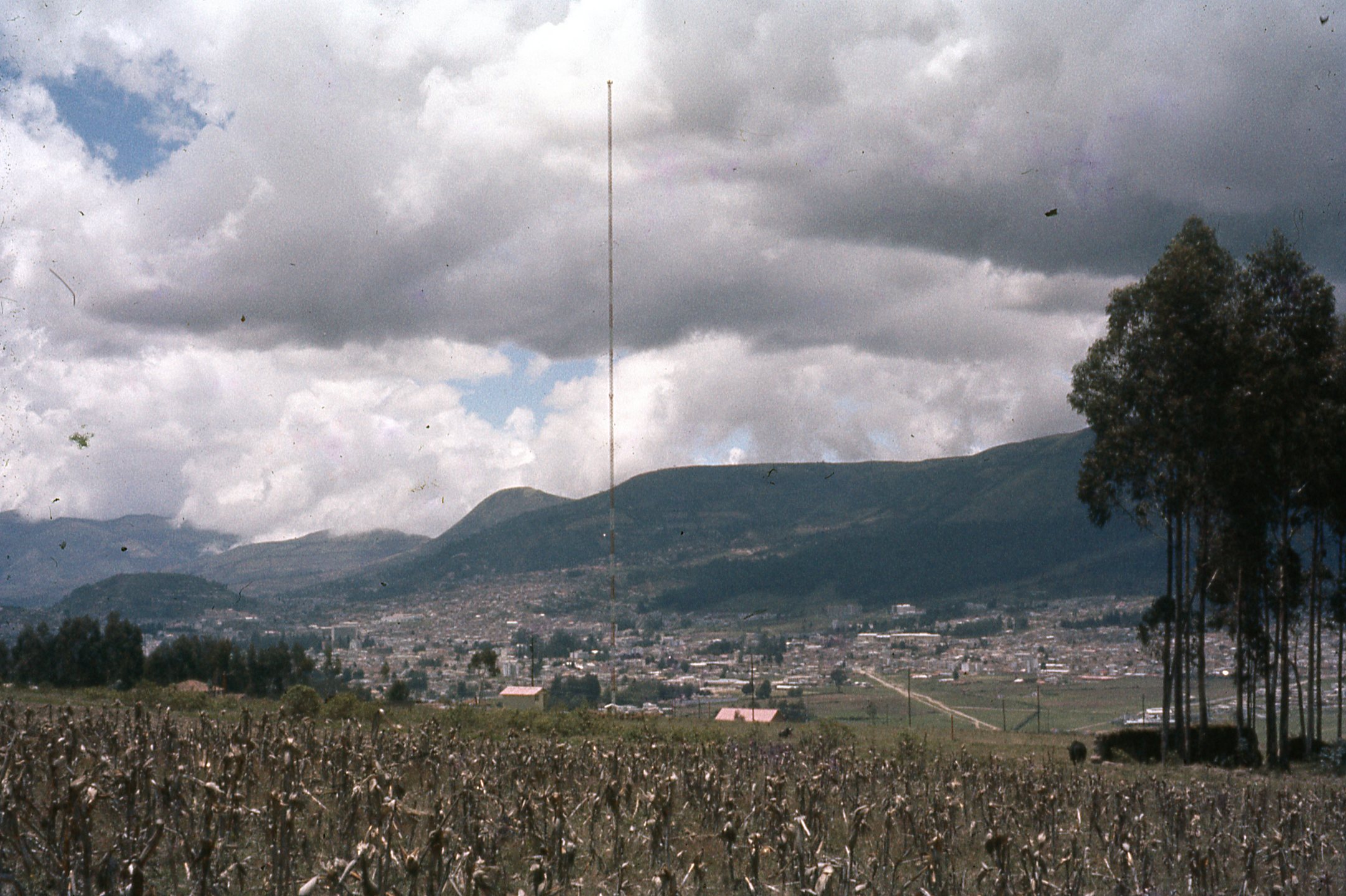 |
HCRM 1 transmitter
site in Bellavista overlooking Quito.
This station fell silent in
1996, 32 years after making radio history
as the first Top 40 station in all South America. |
|
|