I transferred my
syndication and consulting business to Puerto Rico
to be in closer contact with record producers and
several major clients. Syndication activities were
discontinued in 1987 due to tighter currency
exchange regulations in a number of countries which
made payments difficult or impossible. Additionally,
the political situation in several Latin nations
(including the closing and bombing of a major group
client in Panamá) reduced income potential.
Consulting in Puerto Rico
I started looking at
local consulting. The A/C station (WSRA) allowed me
to consult in other formats, so I worked with both
disco/dance WDOY and all-salsa WPRM.
Puerto Rico
Ratings Rankers
Networking to
Cover a Large Market
The WPRM and WIVA
network made up the first instance in the U.S. of
using two FM signals to cover all of a large market.
WPRM covered San Juan and Ponce; WIVA covered
Mayaguez and Arecibo. Together, they covered the
"consolidated" market favored by advertising
agencies. Through use of parallel clustering, spots
could be sold locally on either signal for smaller
retail accounts.
Sales Services
With each ratings
period (Puerto Rico was measured 4 times a year), a
complete set of computer generated rankers was
prepared for advertising agencies and clients.
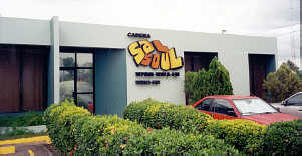
SalSoul was the only broadcaster to provide this
service. As of 1999, Salsoul has been #1 for over 50
consecutive ratings periods.
Cover of the
quarterly ranker booklet that Salsoul prepared
within 12 hours of the release of every rating book
and mailed to clients and agency staffers.
Every significant
demo and every major stations was ranked and cume to
AQH "efficiency" calculated as well as Time Spent
Listening, a concept not directly provided by the
local ratings company.
These two pages and
the blow-up of one of the tables illustrates the
mailing pieces done for Salsoul. Every ratings book
was delivered to WPRM alone on computer disk. I
wrote a program to pull the data for the tables,
calculate TSL and average age, and prepare about 24
tables. All were laid out on a home computer and
delivered the night the book came out to the printer
and mailed the next morning to our list of nearly
1000 agency buyers, AE's and account managers.
This is the cover for
a Salsoul rate card. Rates were increased 8 times in
6 years between 1986 and 1992, going from less than
$25 to over $100 for drive time 60 second spots.
Sales
Increase
This is the cover for
a Salsoul rate card. Rates were increased 8 times in
6 years between 1986 and 1992, going from less than
$25 to over $100 for drive time 60 second spots.
Sales
Increase
In the years between
1986 and 1992, annual sales increases averaged 28%,
while the market never grew at more than a 7% rate.
Expansion in
Florida
In 1989, and unable
to expand in Puerto Rico due to duopoly rules then
in effect, the company purchased several combos in
Florida, the principal being WTNT-FM and WNLS-AM in
Tallahassee.
Although a market leader in ratings, WTNT had never
been profitable. Aggressive promotion, new
management and improved sales promotion turned the
station profitable in just a few months. WNLS, the
sister AM station, was repositioned as an all news
and sports station.
Sales Promotion
in Florida
WTNT and all the ARSO
stations published monthly newsletters for clients
and prospects. These were all prepared in-house in
San Juan.